
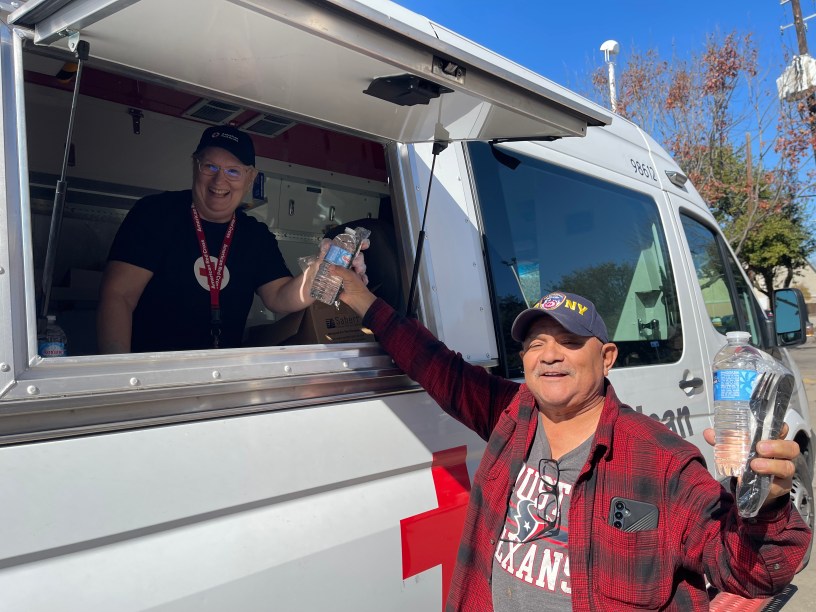
On a cold January day in Houston, an Emergency Response Vehicle (ERV) moved steadily through neighborhoods where Texas’s dangerous freeze had forced many people indoors—or left others searching for warmth and safety. Inside the ERV were two American Red Cross volunteers, Adam Bliven and Lori Crosby. Though they had met only days earlier, they worked together with the ease of longtime partners, united by a shared humanitarian mission and the quiet understanding that comes from serving people on some of their hardest days.
Adam, from Tucson, Arizona, and Lori, from Cottage Grove, Oregon, are two of the many Red Cross volunteers who dropped everything to support Texas communities during this disaster response—affecting our areas.
Adam and Lori have deployed to dozens of disasters, including wildfires, floods and freezes—each time stepping into communities at their most vulnerable moments. On this day, their task was straightforward but vital: picking up hot meals from a local restaurant and delivering them to shelters, serving each person with dignity and care. The hot meals of fried chicken, mashed potatoes, green beans, rolls and fruit were important, but just as meaningful was the way they were given.
Between the two of them, Adam and Lori had already supported communities during this same response in Alice, Jasper and Kingsville, and were eager to help in the Houston area by distributing food at the Denver Harbor, Magnolia and Third Ward shelters. At every location, gratitude was immediate and unmistakable. People walked up to the ERV not only for a hot meal, but for connection—kind words, smiles and the reassurance that someone had shown up for them.
“A hot meal matters,” Adam said, as he carefully filled containers and handed them across tables. “But what matters just as much is looking someone in the eye and letting them know they haven’t been forgotten.”
Between stops, the cab was filled with conversation, occasional laughter and shared stories of work at previous disasters. Disaster response moves quickly, but these moments—between volunteers and with those they serve—are what sustain the work.
Adam, a retired water and wastewater engineer, found his way to the Red Cross after nearly four decades of technical problem-solving. Retirement, he said, left him wanting to continue contributing in a meaningful way. “When you retire, people think you’re done contributing,” Adam said. “I don’t believe that at all. The Red Cross gives me a way to keep solving problems, but now the problem is human, and the solution starts with listening.”
Lori, who back home has worked as an EMT, was drawn to Red Cross disaster response because it offered a way to help people without judgment or agenda—only compassion. “On a disaster response, none of the label’s matter,” Lori said. “You’re not asking how someone got here. You’re asking how you can help them right now.”
At each stop they made, that philosophy was evident. People accepted meals with quiet appreciation and open gratitude. Some shared their stories; others simply said thank you. At the Magnolia site, Mike, a U.S. veteran, spoke with pride and sincerity. “I put my life on the line for this country,” he said. “Now the Red Cross is taking the time to care for me. I cared for them and now they’re caring for me.”
Sitting near him was Keith, who worked as a stagehand for many years before losing his job during the COVID-19 downturn. He explained that he has a home, but no electricity. “You never know what makes someone unhoused or struggling,” Keith said. “Care like this matters more than you know. We appreciate the Red Cross for caring about us.”
When the stops were complete, the Red Cross ensured that food for 200 more were delivered by Adam and Lori to the Star of Hope Women and Family Shelter—making certain that no food, and no opportunity to help, went to waste. Reflecting on this and the entire day’s experiences, Lori said “Even in the middle of a disaster, there’s so much humanity,” Lori said. “People are grateful, they’re kind, and they remind you why showing up still matters.”
Volunteers make up 90 percent of the American Red Cross workforce, traveling from across the country to serve communities in crisis. Though they may arrive as strangers, shared purpose quickly turns into camaraderie. “You don’t come out of a response like this unchanged,” Adam said. “Every deployment reminds you how connected as people we really are.”
As the ERV pulled back into the Red Cross garage at the end of the day, what lingered was not fatigue, but purpose—a reminder that even in rare and dangerous cold, compassion moves freely, carried by volunteers and made possible by donors who ensure help is there when it’s needed most.
You can make a difference for people facing emergencies by supporting the American Red Cross through donations, volunteering your time, or both. To give, visit Ways to Donate to the Red Cross. To learn more about becoming part of the Red Cross family by volunteering, visit Become a Volunteer. Your generosity and commitment will help ensure no one faces a crisis alone.
###
Story By: MaryJane Mudd

 Texas Gulf Coast American Red Cross