
It’s Baby Safety Month, and the Red Cross would like to share some tips on how to care for your little one.
First, it is important to remember that Baby First Aid is different than adult first aid. Babies are more delicate than adults, and they usually have different physiological functions.
So, it is important to be well-versed in child and baby first aid.
First, we will be talking about how to perform proper infant CPR.
Before giving a child or baby first aid, Check the scene for safety, form an initial impression, obtain consent from the parent or guardian, and use personal protective equipment.
If the child or baby appears unresponsive, check the child or baby for responsiveness (shout-tap-shout)
For a child, shout to get the child’s attention, using the child’s name if you know it. If the child does not respond, tap the child’s shoulder and shout again while checking for breathing, life-threatening bleeding or another obvious life-threatening condition
For a baby, shout to get the baby’s attention, using the baby’s name if you know it. If the baby does not respond, tap the bottom of the baby’s foot and shout again while checking for breathing, life-threatening bleeding or another obvious life-threatening condition
CHECK for no more than 10 seconds
If the child or baby does not respond, responds but is not fully awake, is not breathing or is only gasping, or has life-threatening bleeding or another obvious life-threatening condition, immediately call 9-1-1 and give care based on the condition found and your level of training.
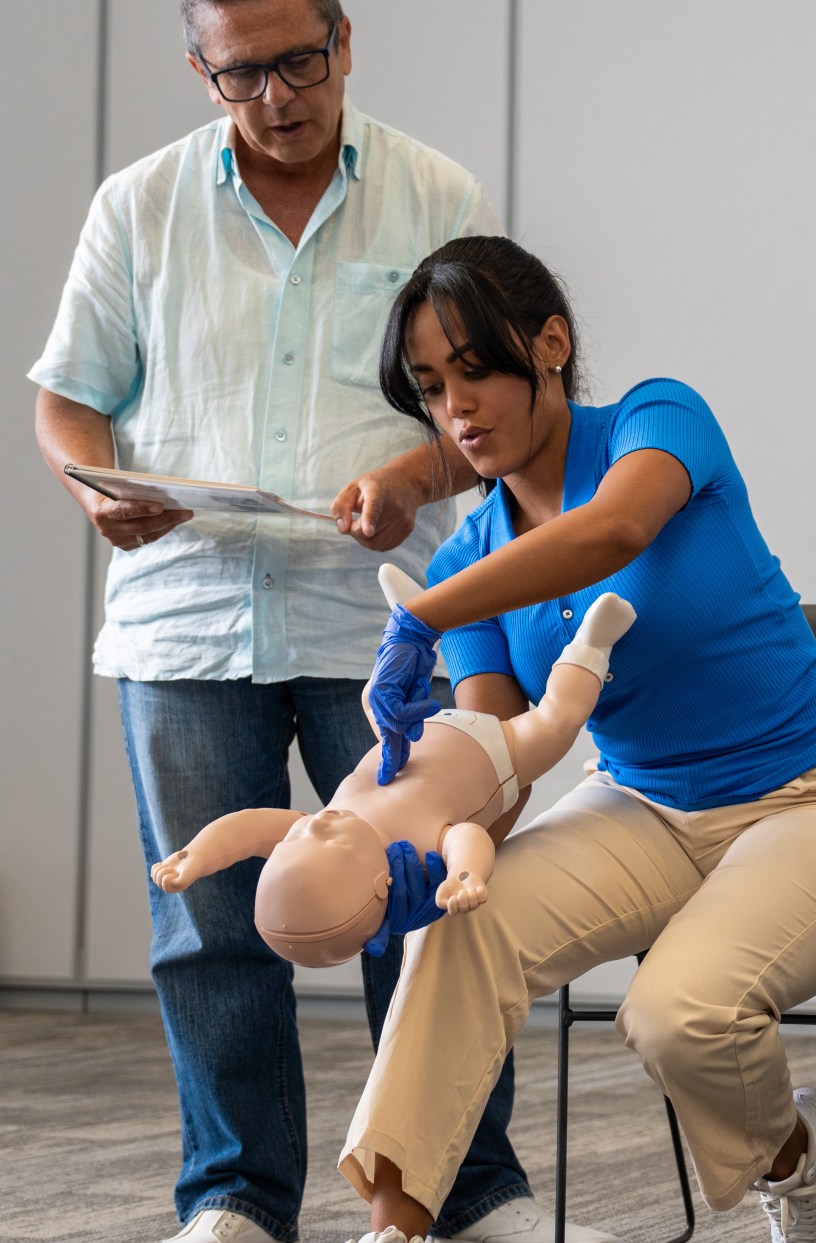
CPR consists of pushing the chest in intervals and combining that action with mouth-to-mouth resuscitation and AED currents. However, regarding infant CPR, it is essential to push on the baby with 2 thumbs, so you don’t break any ribs. Wrap your entire hand around the baby and position both thumbs under the nipple line. Push down hard and fast, with a combination of 30 chest compressions and 2 breaths. It is recommended you perform CPR with additional people in order to prevent tiredness.
Additionally, the AED patches you use should be the smallest size, with one going in the front and the other in the back.
Infant choking techniques are also different from traditional maneuvers, such as the Heimlich. To clear an infant’s airway, position them on your forearm with the head facing down and deliver 5 back blows. Then, turn the infant around and deliver 5 additional chest thrusts, making sure the body is higher than the head. Continue to do this until the infant stops choking.
Additional scenarios include a severe allergic reaction, or anaphylaxis, a head injury, as well as heat exhaustion. In these situations, it is important to call 911 first and comfort the baby. Give proper medication with the correct dosage but remember not to give OTC medications to babies under the age of 2. In the event of heat exhaustion, give the baby plenty of water, give them a cool shower/bath, and keep them in a cool place for the next 24 hours. If the baby continues to feel ill take them to the doctor immediately.
Of course, the key to providing care when it’s needed most is to prepare for the unexpected. Find out how to get First Aid certified in first aid, CPR and AED use from the American Red Cross, or take a refresher course and renew your current first aid certificate, https://www.redcross.org/about-us/our-work/training-education.html.
Story By: Emaan Sheikh

 Texas Gulf Coast American Red Cross